

Kirsten Eisenträger
Penn State University, USA
Kirsten Eisenträger is a Professor of Mathematics at Penn State University. Her research lies at the intersection of number theory, algebra, and computation, with a particular focus on classical and quantum algorithms for number-theoretic problems. She is a Fellow of the American Mathematical Society and has received several distinctions, including an Alfred P. Sloan Research Fellowship and an NSF CAREER Award. In 2020, she was appointed Pentz Professor of Science at Penn State.

Luz de Teresa
UNAM, Mexico
Luz de Teresa is a Professor of Mathematics at the Universidad Nacional Autónoma de México (UNAM). Her research focuses on the control theory of partial differential equations and has made significant contributions to the field. She was elected to the Mexican Academy of Sciences in 2011 and was named an Honorary Member of the Royal Spanish Mathematical Society in 2018. From 2018 to 2020, she served as President of the Mexican Mathematical Society.

Chelsea Walton
Rice University, USA
Chelsea Walton is a Professor of Mathematics at Rice University. Her research lies in noncommutative algebra, with a particular focus on quantum symmetries of algebras and algebraic structures in categories. She has received numerous distinctions for her contributions to mathematics, including election as a Fellow of the American Mathematical Society in 2025, the American Mathematical Society Claytor–Gilmer Fellowship in 2024, the André Lichnerowicz Prize in Poisson Geometry in 2018, and a Sloan Research Fellowship (2017).
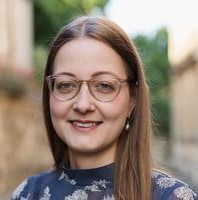
Melanie Weber
Harvard University, USA
Melanie Weber is a Professor of Applied Mathematics and Computer Science at Harvard University, where she leads the Geometric Machine Learning Group. Her research focuses on leveraging geometric structure in data to develop efficient methods with provable guarantees in machine learning and optimization. Prior to joining Harvard, she received her PhD from Princeton University (2021) and was a Hooke Research Fellow at the Mathematical Institute of the University of Oxford (2021–2022). Her distinctions include the IMA Leslie Fox Prize in Numerical Analysis (2023) and an Alfred P. Sloan Research Fellowship in Mathematics (2024).
Title and Abstracts
Kirsten Eisenträger
Title: Cryptography based on supersingular isogenies
Abstract: Cryptosystems based on supersingular isogenies are promising candidates for post-quantum cryptography. Their security relies on the computational hardness of finding isogenies between elliptic curves. This talk presents a graph-theoretic interpretation of the problem, along with an equivalent formulation in terms of computing endomorphism rings. We discuss the main advantages and limitations of isogeny-based cryptosystems and assess their security.
Luz de Teresa
Title: On the Control of the Heat Equation: Existing Results and Challenges
Abstract: In this talk, we present an overview of what control of partial differential equations entails, focusing on the one-dimensional heat
equation. We will discuss several interesting challenges that arise when dealing with coupled systems.
Chelsea Walton
Title: A Century of Frobenius Algebras
Abstract: Born over 100 years ago, Frobenius algebras have undergone a radical transformation from their classical representation-theoretic origins into the backbone of modern Topological Quantum Field Theory. In this talk, we will take a journey from F.G. Frobenius’s 19th-century foundations to the category-theoretic breakthroughs of today. The elegance that makes these algebraic structures indispensable to mathematical physics will be highlighted, and the speaker's recent work on generalizations of Frobenius algebras will also be featured. If you appreciate the beauty of algebra, this talk is for you.
Melanie Weber
Title: Data and Model Geometry in Deep Learning
Abstract: Machine learning methods often perform better when they are designed to respect geometric structure in the data, such as symmetries. This idea has led to highly successful geometric models in areas such as biology, physics, and computer vision. However, we still lack a rigorous theoretical understanding of when and why incorporating such structure makes learning easier. In this talk, we study this question from the perspective of learning theory. Recent results show that training shallow fully connected neural networks, which do not reflect data geometry, can be computationally hard in the statistical query model, a broad framework that captures many gradient-based methods. This motivates our central question: Can prior knowledge about the geometry of the data or the model overcome this fundamental hardness?
We consider three related settings. First, we study equivariant neural networks, which are built to respect known data symmetries. Second, we study learning under the manifold hypothesis, where high-dimensional data are assumed to lie on or near a much lower-dimensional manifold. These settings allow us to ask how geometric assumptions affect the complexity of learning neural networks. Finally, we discuss a related complexity trade-off. Enforcing exact symmetry within a model can provide a useful inductive bias, but it can also be overly restrictive. This raises the question of whether approximate notions of symmetry can serve as softer inductive biases, retaining some of the benefits of geometric structure while allowing greater flexibility.
Acknowledgment: All the above portraits are sourced from the invited lecturers’ respective home pages.